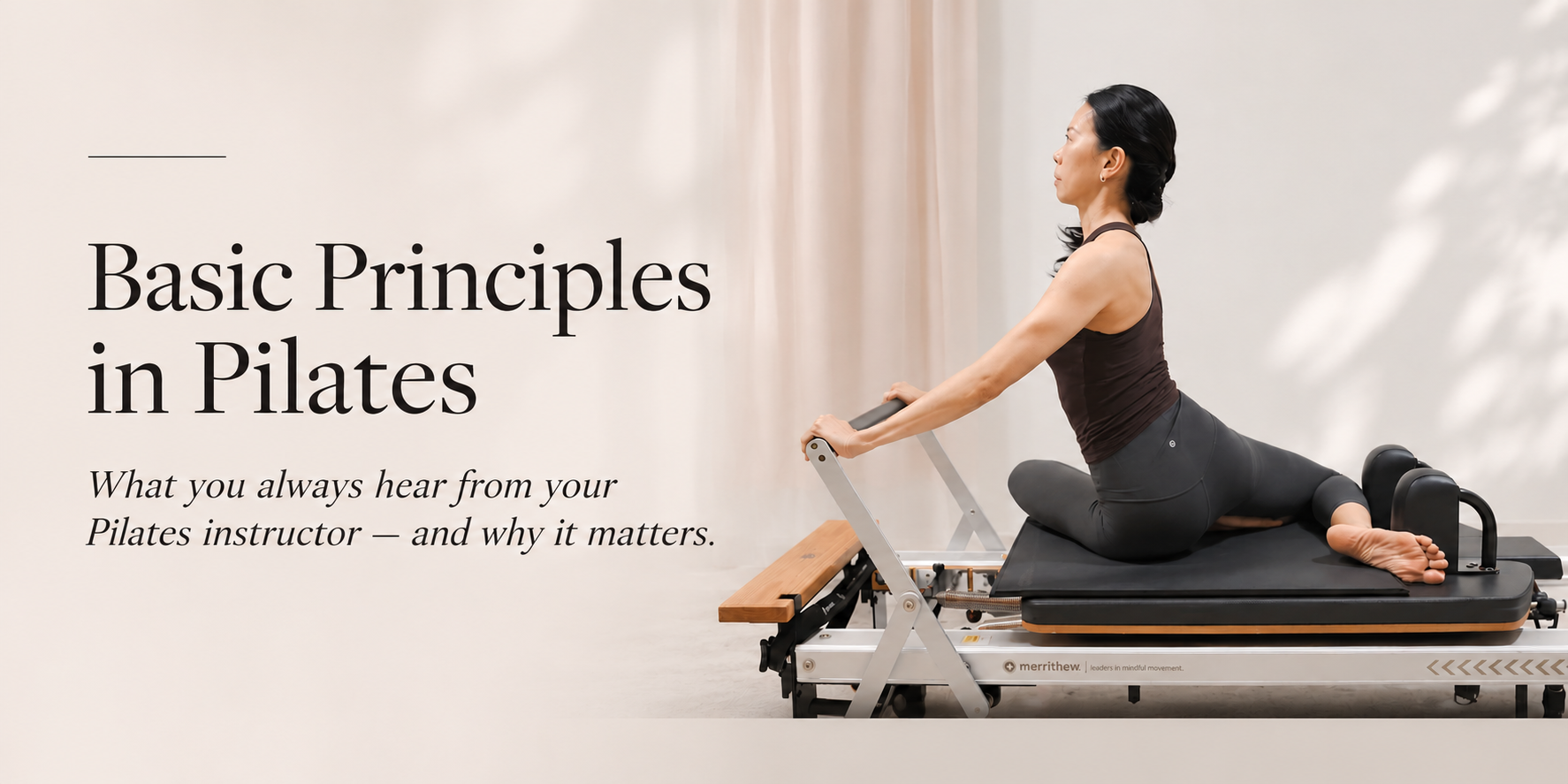
“Breathe into your ribcage.” “Keep your pelvis neutral.” “Relax your shoulders.” “Align your knees with your toes.”
Sound familiar?
If you've attended a Pilates class, chances are you've heard your instructor repeat these cues more times than you can count.
You might even find yourself wondering: Why do we spend so much time thinking about how we move instead of simply doing the exercises?
The answer lies in one of the most important aspects of Pilates: it's not just about what you do, but how you do it.
Pilates encourages us to develop awareness of our bodies, understand how different parts work together, and move with greater control, efficiency and intention.
In STOTT PILATES®, five Basic Principles form the foundation of movement practice. I also like to emphasise a sixth consideration in my teaching: ankle, knee and hip alignment, particularly during standing and weight-bearing exercises.
Let's explore what these principles mean and why they matter beyond the Pilates studio.
1. Breathing — More Than Just Inhale and Exhale
“Inhale through your nose. Exhale through your mouth.”
Breathing is something we do automatically, yet how we breathe can influence the way we move.
In Pilates, we often practise three-dimensional breathing, encouraging the ribcage to expand sideways and towards the back as we inhale.
This allows us to coordinate breathing with movement while developing awareness of the abdominal muscles and the support they provide to the spine.
Why does it matter?
Encourages ribcage mobility and breath awareness.
Supports coordination between breathing and movement.
Helps manage abdominal pressure during exercise.
May help reduce unnecessary tension, particularly around the neck and shoulders.
Try this: Place your hands on the sides of your lower ribcage. As you inhale, imagine your ribs expanding gently into your hands. As you exhale, feel them soften back towards the centre.
The goal isn't to force a bigger breath, but to discover a more natural and efficient breathing pattern.
2. Pelvic Placement — Finding Your Centre
“Find your neutral pelvis.” “Keep your hips level.”
Your pelvis connects your spine to your lower limbs, making it an important part of how your body transfers and manages movement.
In Pilates, we explore two common pelvic positions:
Neutral pelvis: A position that generally maintains the natural curves of the lower spine, without deliberately flattening or exaggerating them.
Imprinted pelvis: A gentle posterior tilt of the pelvis that brings the lower back closer to the mat, sometimes used to provide additional support during selected exercises.
Neither position is universally better. The appropriate choice depends on the exercise, your body and your ability to maintain control.
Why does it matter?
Develops awareness of pelvic and lumbar spine positioning.
Encourages more effective coordination of the abdominal and hip muscles.
Supports control during movements involving the legs and spine.
Helps us recognise habitual movement patterns.
Try this: Lie on your back with your knees bent and feet on the mat. Gently tilt your pelvis forwards and backwards, noticing how the position of your lower back changes. Then find a comfortable position between the two.
Rather than holding your pelvis rigidly, learn to recognise when stability is needed and when movement is appropriate.
3. Ribcage Placement — Connecting Your Upper and Lower Body
“Keep your ribs connected.” “Don't let your ribs flare.”
Have you noticed your lower ribs lifting or pushing forward when you raise your arms overhead?
This is a common movement strategy, particularly when we have limited shoulder mobility or difficulty controlling the relationship between our ribcage and pelvis.
In Pilates, ribcage placement encourages us to maintain an appropriate relationship between the ribs, spine and pelvis, without restricting natural breathing.
Why does it matter?
Supports coordination between the upper body and trunk.
Helps manage excessive movement through the lower back during certain exercises.
Encourages better abdominal control.
Promotes awareness of how the thoracic spine and ribcage move.
Try this: Lie on your back with your arms reaching towards the ceiling. Slowly bring your arms overhead while noticing whether your lower ribs lift or your back arches.
Only move as far as you can comfortably maintain control, allowing your ribcage to respond naturally without excessive flaring.
Remember, the ribcage is designed to move. The goal is not to lock it in place, but to move with awareness.
4. Scapular Movement & Stabilisation — Let Your Shoulder Blades Move
“Keep your shoulders away from your ears.” “Feel your shoulder blades glide.”
Your shoulder blades, or scapulae, play an important role in how your arms, shoulders and upper back function.
One of the most common misconceptions is that good shoulder stability means pulling the shoulder blades down and squeezing them together throughout every exercise.
In reality, healthy shoulder mechanics require both stability and mobility.
Your scapulae should be able to glide, rotate and respond naturally as your arms move.
Why does it matter?
Supports efficient shoulder and arm movement.
Encourages coordination between the shoulder blades and ribcage.
Helps reduce unnecessary muscular tension.
Develops awareness of upper-body movement patterns.
Try this: Raise both arms slowly overhead and notice how your shoulder blades move. Rather than forcing your shoulders down, allow the shoulder blades to rotate naturally as your arms lift.
Stability doesn't mean stiffness. It means having enough control to allow movement where movement is needed.
5. Head & Cervical Placement — Supporting Your Neck
“Keep your neck long.” “Gently nod your chin.”
Our heads spend a significant amount of time looking down at phones, leaning towards computer screens or sitting in forward-head positions.
In Pilates, head and cervical placement focuses on maintaining an appropriate relationship between the head, neck and upper spine.
This doesn't mean keeping your head perfectly straight at all times. It means understanding how your neck moves and how to support it during different exercises.
Why does it matter?
Encourages awareness of head and neck alignment.
Supports more comfortable movement through the cervical spine.
Helps minimise unnecessary neck tension during abdominal exercises.
Promotes coordination between the head, neck and thoracic spine.
Try this: Lie comfortably on your back. Imagine gently lengthening the back of your neck as you make a small nod, without pressing your chin firmly into your chest.
The movement should feel subtle and controlled rather than forced.
Your neck is part of your spine, and like the rest of your body, it benefits from both mobility and support.
6. Ankle, Knee & Hip Alignment — Building a Strong Foundation
“Keep your knees tracking over your toes.” “Maintain even pressure through your feet.”
Although ankle, knee and hip alignment is not listed as a separate principle within the traditional STOTT PILATES® Five Basic Principles, it is an important consideration in my teaching.
Our lower limbs work as a connected system. The way our feet interact with the ground can influence movement at the ankles, knees, hips and pelvis.
This becomes particularly relevant during exercises such as footwork on the Reformer, squats, lunges, standing balance and single-leg movements.
Why does it matter?
Encourages awareness of lower-limb alignment.
Supports coordinated movement through the ankle, knee and hip joints.
Helps develop balance and weight-transfer control.
Builds confidence during functional movements such as walking, climbing stairs and standing up from a chair.
Try this: Stand with your feet comfortably hip-width apart. Notice the contact beneath your heel, the base of your big toe and the base of your little toe.
Slowly bend your knees into a small squat, observing how your knees move in relation to your feet.
Aim for comfortable, controlled movement without forcing your feet or knees into an unnatural position.
Everyone's anatomy is different. Good alignment is not about creating one perfect shape, but finding an efficient and comfortable way for your body to move.
Bringing the Principles Together
These principles are not meant to be six separate instructions that you must constantly remember.
They work together.
When you perform a simple exercise such as Reformer Footwork, you are already exploring several principles at once:
Your breathing helps coordinate the movement.
Your pelvis provides a stable base.
Your ribcage maintains an appropriate relationship with your spine.
Your scapulae rest comfortably and respond to your upper-body position.
Your head and neck remain supported.
Your ankles, knees and hips work together as you press and return the carriage.
Over time, these details become less about consciously following instructions and more about developing a natural sense of how your body moves.
Why Do Pilates Instructors Keep Repeating These Cues?
Because movement awareness takes practice.
Our bodies develop habits through daily activities, work, exercise and lifestyle. Some habits serve us well, while others may limit our movement choices.
Pilates gives us an opportunity to explore those patterns.
The purpose of an instructor's cue is not to make every movement look identical. It is to help you notice what your body is doing, explore different strategies and gradually develop greater control.
And here's something worth remembering:
There is no single perfect posture or alignment that suits every person, every exercise or every situation.
Our bodies are designed to move, adapt and respond.
The goal is not to hold ourselves in one ideal position all day, but to build the awareness, strength and mobility to move comfortably in different ways.
My Approach: Move with Understanding
As a Pilates and GYROTONIC® instructor, I believe that understanding movement is just as important as performing it.
The more we understand how our bodies work, the more confident we become in exploring what they can do.
Whether you're new to Pilates or have been practising for years, these basic principles offer a foundation to revisit, refine and build upon.
The next time your instructor reminds you to breathe, find your pelvis or soften your shoulders, consider it an invitation to become a little more curious about your movement.
Because Pilates isn't about achieving perfect movement.
It's about developing awareness, discovering possibilities and learning to move with greater ease, confidence and freedom.
Move with awareness. Move with intention. Move with understanding.
Celia Ho
STOTT PILATES® Certified Instructor | ZEN•GA® Qualified Instructor | GYROTONIC® Certified Trainer
Explore more about my movement philosophy and teaching approach at www.celiapilates.com.